 par
While the media is saturated with the crisis in Ukraine, the 2026 migration crisis in Ceuta, which made headlines for a few days, already seems to have been forgotten.
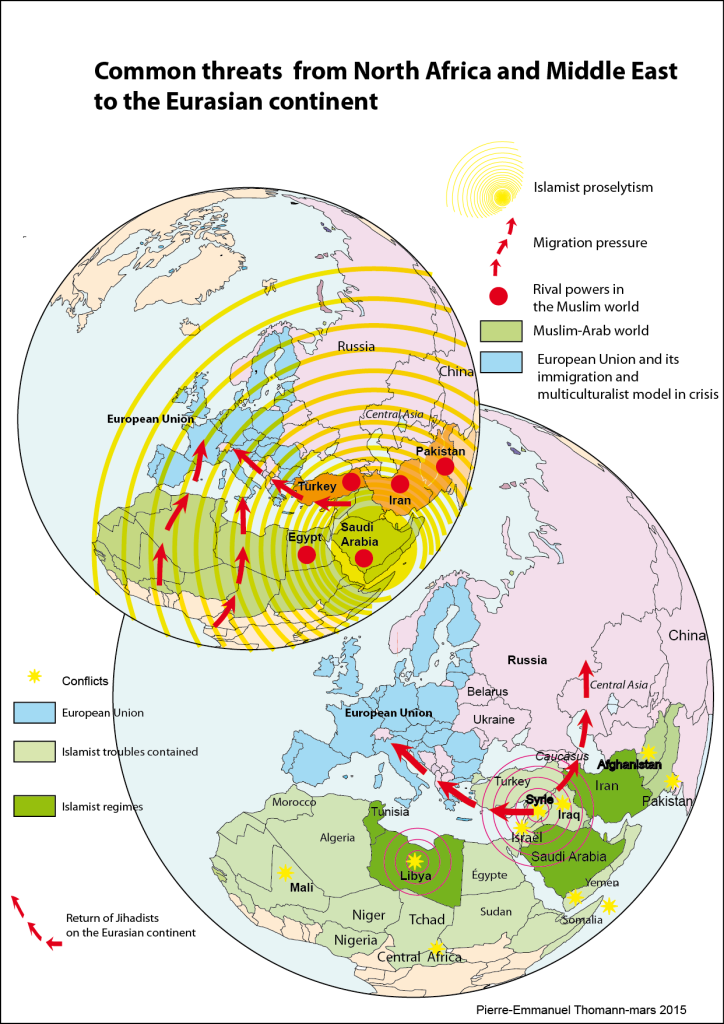
Migration crises are nevertheless among the major geopolitical threats for Europeans, because they generate uncontrolled immigration that also threatens the security and national cohesion of European states, with a mechanical increase in delinquency, ethno-religious conflicts, and worse, Islamist terrorist attacks.
The migration crises in Ceuta (2021 and 2026), like the migration crisis in Greece from Turkish territory in 2014, have multiple causes—geopolitical, demographic, political—though taking different forms.
The lessons of these crises are multiple from a geopolitical point of view.
These successive migration crises have demonstrated that the EU is still not in a position to help protect the borders of member states. The European Agency for the Management of Operational Cooperation at the External Borders (Frontex) was created in 2004, but it was never given the means to act decisively to anticipate migration crises. Worse, the EU, most of its member states, and NGOs put obstacles in its way by prioritizing almost exclusively a humanitarian and legalistic vision, which led to the impunity of human smugglers and to prioritizing the rights of migrants, even illegal ones, while encouraging funding for pro-immigration NGOs. The opening in 2026 of an official judicial investigation for complicity in crimes against humanity against former Frontex director Fabrice Leggeri, following a complaint by the Human Rights League (LDH), is telling in this regard.
The EU, which sends billions to Kyiv, has still not made serious progress in protecting its borders and continues its ideology of the open society, despite developing policies aimed at limiting illegal migration, but through means that will act only cosmetically. The majority of member states and the EU also lack the political will to counter third countries that manipulate or even encourage these crises, particularly Turkey. On the other hand, they accused Belarus and Russia in this regard, even though the migrant flows concerned are minimal compared to those on the southern borders in the Mediterranean, and based mostly on assumptions. A blatant double standard, all the more so given that criticism of Turkey and Morocco has been greatly muted.
EU member states can thus be subjected to blackmail by third countries. In the case of the 2026 crisis in Ceuta, the Moroccan government was accused of laxity in preventing these flows, and even criticized for encouraging them, within the context of its dispute with Spain over Western Sahara. This crisis broke out following Pedro Sánchez’s visit to Algiers on July 20, 2026, intended to warm relations with Algeria, Morocco’s regional rival, and after a committee of the Spanish Parliament adopted a draft bill facilitating access to Spanish nationality for Sahrawis born under Spanish colonial administration, two elements that Rabat may have perceived as hostile regarding the Western Sahara issue. The 2021 crisis in Ceuta, for its part, broke out following a deliberate relaxation of Moroccan controls, in reaction to Spain providing medical care to the leader of the Polisario Front, Brahim Ghali.
In the case of the 2015 migration crisis, it can be concluded that Turkey was largely co-responsible, by practicing blackmail on the EU to obtain funds intended to retain migrants, which gave rise to the agreement of March 18, 2016, organizing the outsourcing of European asylum law to Turkey. One can also hypothesize that Turkey aimed to reduce criticism from EU member states regarding its policy of geopolitical interference in Syria.
Nor should one overlook the responsibility of European states themselves, which, in alliance with the United States, promoted regime changes and engaged in military operations that destabilized states south of the Mediterranean—such as the 2003 aggression against Iraq and, in the wake of the Arab revolutions largely supported by Western powers, the 2011 intervention in Libya and interference in Syria from that crisis up to the present day.
Internal causes are equally important, such as the pull factor caused by the Spanish Prime Minister and his policy of regularizing illegal immigrants in Spain. The contagion of the Ceuta crisis to the rest of the European continent did not occur, for the sole reason that Ceuta is an enclave south of the Mediterranean. A few years earlier, Angela Merkel’s decision to open Germany’s borders during the 2015 crisis had also aggravated the situation, the negative effects of which are still felt today.
Finally, EU member states remain powerless due to their lack of political will to take appropriate measures, such as rebuilding national borders and strengthening European borders, but also reforming or definitively exiting the Schengen agreements, and questioning the pro-immigration ideology underlying the EU’s liberal and globalist model, with its promotion of the open society, human rights ideology, and economic liberalism.
EU member states are also deeply divided on this question, along a clear divide between Western Europe and Central and Eastern Europe, but also within the societies of member states themselves, where the migration question is the subject of growing debate. One recalls the crisis between Germany and Hungary regarding the management of the Mediterranean migration crisis in 2015. Regarding the Ceuta crisis, despite official statements of support, member states remain at odds over migration issues. The disagreement is even more pronounced between an increasing number of citizens who reject mass immigration and governments, under the influence of the liberal and globalist model, that evade the question, avoid making effective decisions, or settle for cosmetic measures that change nothing about the state of unreadiness for migration crises, and refuse to consider exiting the European Convention on Human Rights and open-border ideologies, as requested by certain opposition parties.
Ultimately, migration crises are geopolitical crises before being humanitarian or economic crises, as human rights activists attempt to depict them exclusively. The deep issues of a geopolitical nature are thus glossed over or simplified, most often, in political and media debates, because they are politically sensitive. Emotion takes precedence over reflection, and decisions are made through the prism of « multiculturalist » and « unrooted » ideologies dominant in European institutions and widespread among ruling political parties in European capitals. It is nevertheless necessary to examine the « unspoken truths » of this crisis to avoid denial when facing the geopolitical crises that will inexorably come.
The geopolitical stakes of these crises are in reality the following: The question of power rivalries over the control of borders and territory, issues linked to the paramount interests of nations, but a control eroded by the EU and its integrationist project, ideologically oriented, as mentioned, by the liberal open society. – The security of European Union nations, as the disintegration of European societies caused by uncontrolled and unassimilable immigration prepares future conflicts on their own territory, all the more so if these crises and fractures are weaponized by third countries, as is actually always the case.
The sustainability of the very essence of European nations, and thus of European civilization, as the uncontrolled and ever-growing influx of populations coming from areas facing economic difficulties or crossed by conflicts, such as the Maghreb, the Near East, Southwest Asia, or undergoing continuous demographic growth, such as Africa, endangers the balances between indigenous Europeans, non-European populations that integrate and assimilate (and are thus compatible with the nation-state model and European values), and those that do not, due to the growing failure of multiculturalism alongside the rise of political and radical Islam.